

Skip to content
MindTrace

CBT thought diary · iPhone and Android

The thought diary that gets you ready for therapy

Capture thoughts by typing or voice. See your patterns. Get a clear summary before every session.

5.0 on the App StoreFree on iPhone and Android · 7-day free trial
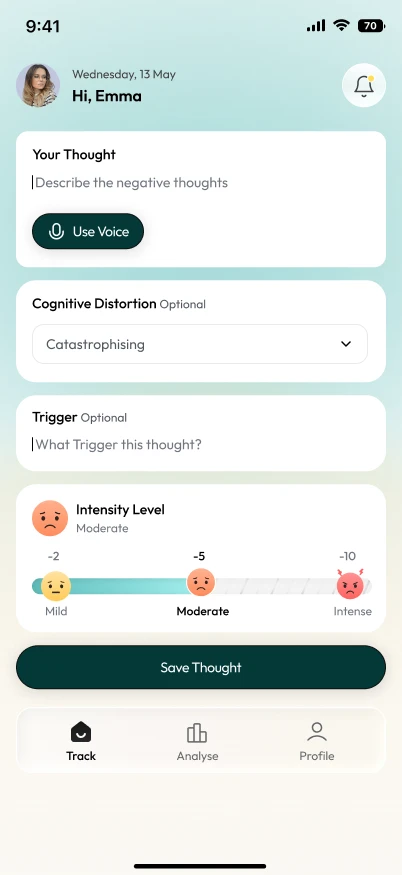
Logging a thought in MindTrace with distortion, trigger and intensity

Grounded in CBT. Private by design.

  • Based on CBTThought records
  • EncryptedOnly you can see it
  • Type or voiceSeconds to log
  • UK GDPRNever sold

Why it helps

“How have things been since we last spoke?” is hard to answer from memory

MindTrace captures the moments as they happen, then organises them, so you arrive with real examples, patterns and reflections.

01 Capture

Record thoughts the moment they happen

Type or use voice. Tag the distortion and trigger if you want, rate the intensity, done.

Thought entry screen

Your patterns

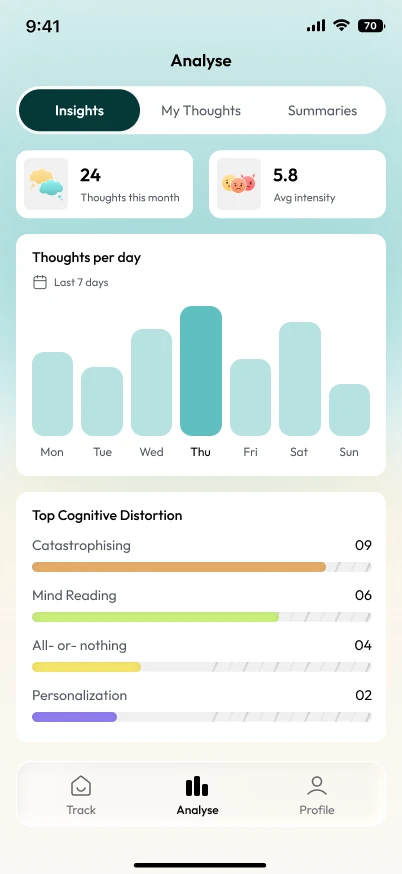
Know which thinking traps show up most

  • Catastrophising
  • Mind reading
  • All-or-nothing

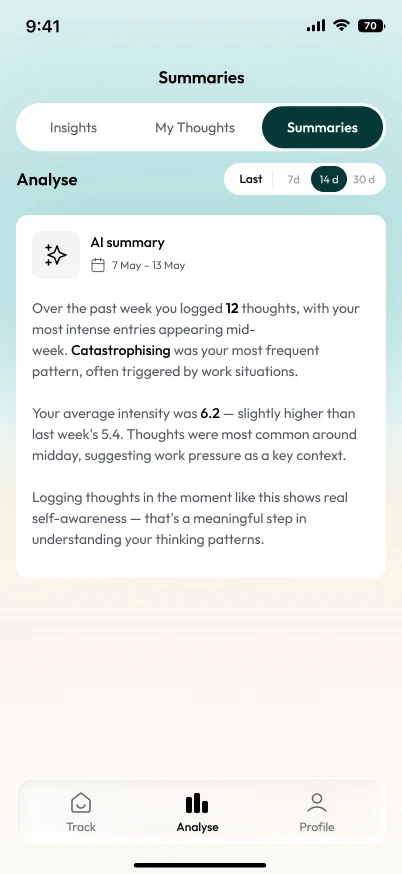
03 Prepare

A summary written for your next session

Read it before your session, or email it to your therapist from the app.

AI summary screen
Insights screen

02 Understand

See your week at a glance

Thoughts per day, average intensity and your most common distortions, so common triggers and changes in mindset become visible.

Calvin Field, founder of MindTrace

Our story

Built from my own experience in therapy

Hi, I’m Calvin, the founder of MindTrace. MindTrace grew out of my own experiences in therapy. I found it difficult to remember my thoughts and emotions between sessions, the very moments that often mattered most.

I realised I wasn’t alone in this, and it sparked an idea: what if there was a simple way to capture those thoughts in real time and bring them into therapy?

That’s why I built MindTrace, a companion app that helps people log their thoughts, recognise patterns and share clearer insights with their therapists.

My mission is simple: to make therapy more effective, conversations more meaningful, and mental health outcomes stronger.

Calvin Field · Founder, MindTrace
From the blog

All articles →

Questions

Is MindTrace based on CBT?

Yes. It uses CBT techniques like thought records and spotting cognitive distortions. It supports therapy and is not a treatment in itself.

Are my thoughts private?

Entries are encrypted and only you can see them. We never sell your data, and you can delete everything at any time.

Can MindTrace replace therapy?

No. It is a companion that helps you remember what happened between sessions. If you are in crisis, contact your local emergency number.

Can I share my entries with my therapist?

Yes. You can email your thought summary to your therapist straight from the app, so they can read it before your session. Nothing is sent to anyone unless you choose to send it.

More questions
Do I need to be in therapy to use MindTrace?

No. MindTrace is designed to work alongside therapy, but many people use it while on a waiting list, between courses of therapy, or after therapy has ended to keep their CBT skills going.

Will my therapist understand the terms MindTrace uses?

Yes. Labels like catastrophising, mind reading and all-or-nothing thinking are standard cognitive distortions from CBT, so your summaries use language your therapist will recognise.

Which devices does MindTrace work on?

MindTrace is available on iPhone and Android.

How long does it take to log a thought?

A few seconds. Type it or use voice, then add a distortion, trigger or intensity rating if you want to. Those extra fields are optional.

Get more from every session